 by Printer Brands
 Label Tape
 Ink
Ink Toner
Toner Label Roll




 Ribbon













 Label Printers
 Office Supplies
 Other
Other
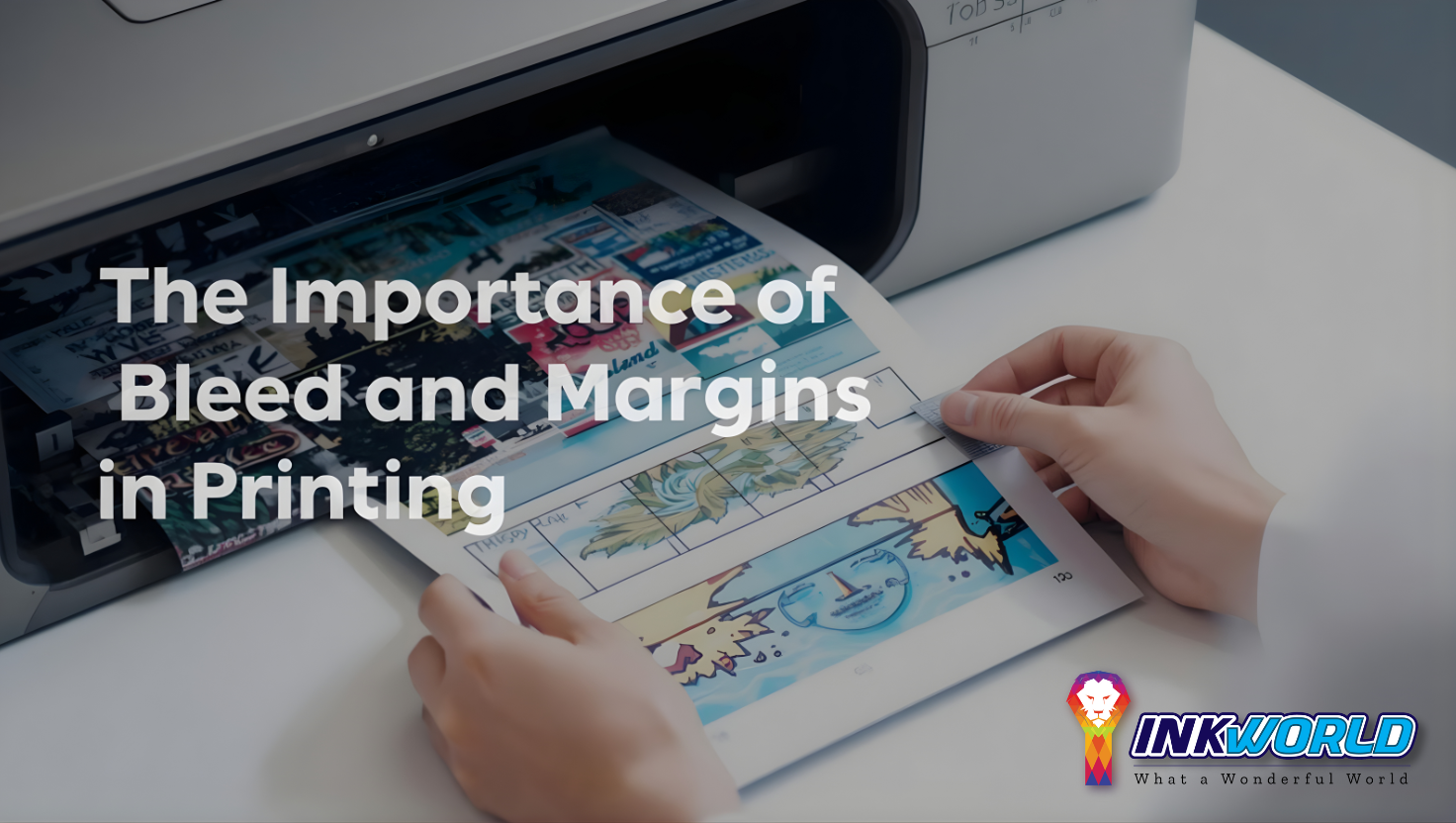
For photographers and designers in Singapore, understanding bleed and margins is crucial to achieving professional print results. Whether you’re printing gallery-worthy photographs, business materials, or personal projects, these technical specifications can make the difference between amateur-looking prints and polished, professional output. This guide explores everything you need to know about bleed and margins for high-resolution printing, specifically tailored to Singapore’s printing standards and photo printer capabilities.
What Are Bleed and Margins?

The essential components of print layout: bleed area (outer red section), trim line (black), margins (blue), and safe content area (white)
Before diving into the technical details, let’s clarify what bleed and margins actually are in the printing world:
Bleed
Bleed is the area that extends beyond the final trim size of your document. When you want colour or images to extend to the edge of the page, you need to use bleed. This extra area (typically 3mm in Singapore) allows for slight variations in the trimming process, ensuring there are no white edges on your final print.
Margins
Margins are the safe areas inside the trim line where important content should be placed. Proper margins (usually 5-10mm in Singapore) ensure that no critical elements, such as text or important parts of images, are cut off during trimming or hidden in the binding process for multi-page documents.
Understanding these concepts is essential when preparing files for any type of printing, but particularly crucial for high-resolution photography printing where precision and quality are paramount.
Why Bleed Matters in Photography Printing
For photographers in Singapore using high-quality photo printers, bleed is not just a technical requirement—it’s essential for achieving professional results. Here’s why:
- Borderless Printing: When you want your photographs to extend to the very edge of the paper without white borders, proper bleed is non-negotiable. Most photo printers in Singapore that can print borderless still require bleed settings in your file.
- Precision Trimming: Even the most advanced cutting equipment has minimal tolerance variations. Bleed compensates for these slight shifts, ensuring your final prints look exactly as intended.
- Professional Appearance: White edges on borderless prints immediately signal amateur preparation, regardless of how stunning the photograph might be.
- Print Consistency: When producing multiple copies, proper bleed ensures consistency across the entire batch, particularly important for exhibitions or client deliverables.
“The difference between amateur and professional printing often comes down to technical details like proper bleed. It’s the invisible element that makes your photographs look seamless and professional.”
The Critical Role of Margins in Print Quality

Proper margins ensure that critical elements remain visible and aren’t cut during the trimming process
While bleed extends your content beyond the trim line, margins create a safety zone within it. For high-resolution photography printing in Singapore, margins serve several crucial functions:
Content Protection
Margins ensure that important elements of your photograph aren’t accidentally trimmed away. This is especially crucial for images where every detail matters, such as architectural photography or portraits, where subject positioning is precise.
Aesthetic Balance
Proper margins create visual breathing room around your images, enhancing their impact. Professional photographers understand that negative space is as important as the subject itself, and margins help maintain this balance.
Text Legibility
For prints that combine images with text (such as exhibition labels or photo books), margins ensure that text remains fully visible and doesn’t run too close to the edge of the page.
Handling Space
Practical margins provide space for handling the print without touching the actual image area—important for gallery presentations and professional handling.
Singapore Printing Tip: In Singapore’s humid climate, paper can sometimes expand slightly. Professional printers recommend adding an extra 1-2mm to your standard margins to account for potential paper movement during printing, especially for high-value fine art prints.
Technical Specifications for Singapore Printing Standards
Singapore follows international printing standards with some specific local practices. Understanding these specifications is essential when preparing files for local photo printers:
| Print Type | Standard Bleed | Recommended Margins | Resolution | Color Space |
| Standard Photo Prints | 3mm | 5mm | 300 dpi | sRGB/Adobe RGB |
| Fine Art Prints | 3-5mm | 10mm | 300-360 dpi | Adobe RGB/ProPhoto RGB |
| Exhibition Prints | 5mm | 15mm | 300 dpi | Adobe RGB |
| Photo Books | 3mm (6mm in gutter) | 15mm (20mm in gutter) | 300 dpi | sRGB/Adobe RGB |
| Business Cards | 3mm | 5mm | 300-600 dpi | CMYK |
Singapore Paper Sizes and Bleed Requirements
Singapore primarily uses the international ISO paper sizes (A series), with some influence from US sizes for certain applications. Here are the common sizes with their corresponding bleed requirements:
| Paper Size | Dimensions (mm) | Required Bleed Size (mm) | Final File Size with Bleed (mm) |
| A4 | 210 × 297 | 3mm on all sides | 216 × 303 |
| A3 | 297 × 420 | 3mm on all sides | 303 × 426 |
| 4R | 102 × 152 | 3mm on all sides | 108 × 158 |
| 5R | 127 × 178 | 3mm on all sides | 133 × 184 |
| 8R | 203 × 254 | 3mm on all sides | 209 × 260 |

Common paper sizes in Singapore with bleed areas highlighted in red
Common Bleed and Margin Mistakes to Avoid
Even experienced photographers and designers in Singapore sometimes make these common mistakes when preparing files for photo printers:
Common Mistakes
- No Bleed at All: Assuming borderless printing doesn’t require bleed settings in your file.
- Insufficient Bleed: Using only 1-2mm when 3mm is the standard minimum in Singapore.
- Ignoring Margin Safety: Placing important elements too close to the edge of the document.
- Inconsistent Margins: Having different margin widths on different sides creates an unbalanced look.
- Forgetting Binding Considerations: Not adding extra margin space for the binding edge in multi-page documents.
- Assuming All Printers Are the Same: Not adjusting bleed and margins based on specific printer capabilities.
Best Practices
- Always Include Bleed: Use a minimum 3mm bleed for all borderless prints in Singapore.
- Use Margin Guides: Set up proper margin guides in your design software before starting your layout.
- Check Printer Specifications: Verify the specific requirements of your chosen photo printer.
- Use Templates: Start with professionally created templates that already have proper bleed and margins set up.
- Preview Before Printing: Use software preview tools to check how your document will look after trimming.
- Consult with Print Professionals: When in doubt, ask your Singapore print service for their specific requirements.
Need Help Setting Up Your Files Correctly?
Print experts in Singapore can review your files and ensure they’re set up with proper bleed and margins before printing. Save time and avoid costly reprints!
Visit Now!Setting Up Bleed and Margins in Popular Software
Different software packages handle bleed and margins differently. Here’s how to set them up correctly in the most popular programs used by photographers and designers in Singapore:
Adobe Photoshop

- Go to File > New
- Enter your document dimensions
- For bleed: Increase canvas size by 3mm on each side
- For margins: Create guides at 5-10mm from each edge
- Use rulers (Ctrl+R) to drag guides for margin visualisation
Adobe InDesign

- Go to File > New > Document
- Enter your document dimensions
- In the Bleed section, enter 3mm for all sides
- In the Margins section, enter 5-10mm for all sides
- Click Create to generate your document with bleed and margins
Affinity Photo

- Go to File > New
- Enter your document dimensions
- Check “Document has bleed” and enter 3mm
- Click OK to create the document
- Go to View > Show Guides
- Add margin guides at 5-10mm from each edge
Pro Tip: Most professional photo printers in Singapore can provide templates with proper bleed and margin settings already configured. Always ask if these are available before starting your design work.
Photo Printer Considerations for Bleed and Margins

Professional photo printers are commonly used in Singapore with borderless printing capabilities
Different photo printers handle bleed and margins differently, which is important to understand when preparing your files in Singapore:
Printer Types and Their Bleed Capabilities
| Printer Type | Borderless Capability | Minimum Bleed Required | Special Considerations |
| Consumer Photo Printers | Most support borderless | 3mm | May have limitations on paper types for borderless printing |
| Professional Desktop Printers | Most support borderless | 3mm | Better precision, but still requires proper bleed settings |
| Large Format Printers | Varies by model | 3-5mm | May have specific borderless sizes; check manufacturer specs |
| Commercial Print Machines | Always require bleed | 3-5mm | Higher precision, but still requires proper file preparation |
Popular Photo Printer Models in Singapore
Epson SureColor P-Series
These high-end photo printers are popular among professional photographers in Singapore. They support borderless printing but require proper bleed settings in your files. The P700 and P900 models are particularly common in Singapore studios.
Canon imagePROGRAF PRO Series
These professional printers offer excellent borderless printing capabilities, but have specific requirements for bleed. The PRO-1000 is widely used in Singapore for high-quality photo printing.
Canon PIXMA PRO Series
More affordable than the imagePROGRAF line but still capable of professional results. The PIXMA PRO-200 is popular among Singapore photographers for its excellent colour reproduction.

Close-up of a high-resolution photograph being printed with visible bleed marks and crop indicators
Important: Even printers advertised as “borderless” require proper bleed in your file preparation. The printer’s borderless capability means it can print to the edge of the paper, but your file still needs to extend beyond the trim line to ensure complete coverage.
Singapore Market: Local Printing Standards and Practices

Professional printing services in Singapore offer expertise in high-resolution photo printing
The Singapore printing market has some unique characteristics that photographers and designers should be aware of when preparing files with proper bleed and margins:
Local Standards and Preferences
- Metric System Dominance: Singapore primarily uses the metric system for all printing specifications, with measurements in millimetres as the standard.
- Paper Size Preferences: While international ISO sizes (A4, A3, etc.) are standard, photo printing often uses inches-based sizes like 4R (4×6″), 5R (5×7″), and 8R (8×10″).
- Higher Humidity Considerations: Singapore’s humid climate affects paper handling and sometimes requires slightly larger margins to account for paper expansion.
- Print Service Providers: Major printing hubs in Singapore include Funan, Peninsula Shopping Centre, and Bras Basah Complex, each with slightly different standard practices.
Finding Professional Printing Services in Singapore
Singapore offers numerous high-quality printing services that specialise in photography and high-resolution printing:
Cathay Photo
One of Singapore’s oldest and most respected photography retailers also offers professional printing services with expert guidance on file preparation.
Locations: Peninsula Shopping Centre, Funan
Fotohub
Specialises in high-quality photo printing with excellent colour calibration and file preparation assistance.
Locations: Multiple outlets, including Funan and Tampines
Artisan Prints
Boutique printing service focused on fine art and exhibition-quality prints with meticulous attention to bleed and margin details.
Location: Jalan Besar
High-Resolution Printing and Its Relationship to Bleed and Margins
Resolution Requirements
For high-quality photo printing in Singapore, the standard resolution is 300 dpi (dots per inch). However, some fine art applications may benefit from 360 dpi or even 600 dpi. Higher resolution means more detail, which makes proper bleed and margins even more critical—you don’t want to lose any of that detail during trimming.
File Size Considerations
High-resolution files with proper bleed will be larger. For example, an A4 photo at 300 dpi with a 3mm bleed will be approximately 35 MB in uncompressed TIFF format. Ensure your software and hardware can handle these larger files during preparation.
Color Management
High-resolution printing in Singapore typically uses colour-calibrated workflows. When setting up your document with bleed, ensure that colour profiles are correctly embedded and that any elements extending into the bleed area maintain colour consistency with the main content.
Detail Preservation
With high-resolution printing, fine details become visible. Ensure that any important fine details remain well within the safe margin, as even a slight trimming variation could affect their visibility.
Ready to Create Perfect High-Resolution Prints?
Singapore studio specialises in high-resolution photography printing with meticulous attention to bleed and margins. Upload your files for a professional assessment and printing quote.
Get a Printing QuoteTemplates and Resources for Perfect Bleed and Margins

Professional printing templates with clearly marked bleed areas, trim lines, and margin guides
To simplify the process of setting up proper bleed and margins for your photography printing in Singapore, here are some valuable resources:
Free Templates and Guides
Singapore-Specific Templates
- Cathay Photo’s Print Templates (A4, 4R, 5R, 8R sizes)
- Fotohub Singapore Size Guides
- Artisan Prints Fine Art Templates
Software Templates
- Adobe InDesign Print Templates
- Photoshop Photography Print Templates
- Affinity Photo Document Presets
- Canva Pro Print Templates
Online Resources
- PrintNinja’s Bleed Calculator
- Printful’s Template Generator
- Adobe’s Print Resource Centre
- Singapore Graphic Artists Association Guides
Visit InkWorld.sg
Get to professional and informative blogs about proper bleed and margins for all standard Singapore print sizes. Perfect for photographers and designers!
Learn MoreCase Studies: The Impact of Proper Bleed and Margins

Before (left) and after (right): The impact of proper margins on a photography exhibition in Singapore
Case Study: Singapore Photography Exhibition
A local photographer prepared 20 large prints for an exhibition at the Objectifs Centre for Photography and Film. Initially, the prints were prepared without proper bleed, resulting in white edges on some prints and inconsistent margins that created a disjointed look when displayed together.
After consulting with a professional print service, the photographer resubmitted the files with proper 5mm bleed and consistent 15mm margins. The result was a cohesive, professional-looking exhibition, with all prints featuring consistent edges and spacing, significantly enhancing the visual impact of the work.
“The difference was remarkable. What looked like amateur work suddenly appeared gallery-ready, simply by correcting the technical specifications of bleed and margins.”
Case Study: Commercial Photography Portfolio
A Singapore-based commercial photographer created a portfolio book to showcase work to potential clients. The first version was printed without accounting for the gutter margins in the binding, resulting in important parts of the images disappearing into the spine of the book.
After adjusting the layout with proper inner margins (20mm at the binding edge) and consistent outer margins (10mm), the second printing allowed all images to be fully visible and created a much more professional impression with clients.

Photography portfolio with proper gutter margins, ensuring all image content remains visible
Frequently Asked Questions About Bleed and Margins
What is the difference between bleed and margins?
Bleed is the area that extends beyond the final trim size of your document, ensuring that printed colour or images reach all the way to the edge after trimming. Margins, on the other hand, are safe zones within the trim line where important content should be placed to prevent it from being cut off during trimming. In Singapore printing, the standard bleed is typically 3mm, while margins are usually 5-10mm, depending on the application.
Do I need to bleed if I’m printing with white borders?
If you’re intentionally printing with white borders, you technically don’t need bleed. However, many professional printers in Singapore still recommend including bleed for consistency in file preparation and to allow flexibility if you later decide to print the same image borderless. It’s generally good practice to include bleed in all print files.
What are the standard bleed measurements in Singapore?
In Singapore, the standard bleed for most printing is 3mm on all sides. For large-format printing or speciality applications, a 5mm bleed may be recommended. Always check with your specific print service provider, as requirements can vary slightly between different printing companies in Singapore.
How do bleed and margins affect the cost of printing in Singapore?
Proper bleed and margins don’t directly affect printing costs in Singapore. However, incorrect bleed and margins that result in reprints can significantly increase your costs. Some professional print services in Singapore may charge additional fees for fixing improperly prepared files, so getting it right the first time is cost-effective.
Can my home photo printer handle bleed properly?
Most modern home photo printers in Singapore can handle borderless printing, but their precision may not match commercial printers. When printing borderless at home, you should still prepare files with proper bleed, but be aware that consumer printers often achieve borderless printing by slightly enlarging the image, which may crop some content around the edges. Check your specific printer’s manual for borderless printing specifications.
What resolution should I use for high-quality photo printing in Singapore?
For high-quality photo printing in Singapore, the standard resolution is 300 dpi (dots per inch). For fine art or exhibition prints, some Singapore print services recommend 360 dpi. Remember that when adding bleed to your document, maintain this resolution throughout the entire file, including the bleed area.
Conclusion: The Professional Edge of Proper Bleed and Margins

Attention to technical details like bleed and margins separates amateur from professional printing results
Understanding and implementing proper bleed and margins is not just a technical requirement—it’s what separates amateur printing from truly professional results. In Singapore’s competitive photography and design market, these details matter significantly.
By following the guidelines outlined in this article, you can ensure that your high-resolution photography prints maintain their visual impact and professional appearance. Whether you’re printing for a gallery exhibition, a client portfolio, or personal projects, proper bleed and margins will enhance the quality and presentation of your work.
Remember that Singapore’s printing standards align with international best practices but may have specific local considerations, particularly regarding paper sizes and humidity factors. Working with established local print services can help you navigate these nuances effectively.
The time invested in learning and applying proper bleed and margin techniques will pay dividends in the quality of your printed materials and the impression they make on viewers and clients alike.
Ready to Take Your Printing to the Next Level?
Singapore printing experts specialise in high-resolution photography printing with meticulous attention to technical details like bleed and margins.
Learn more